



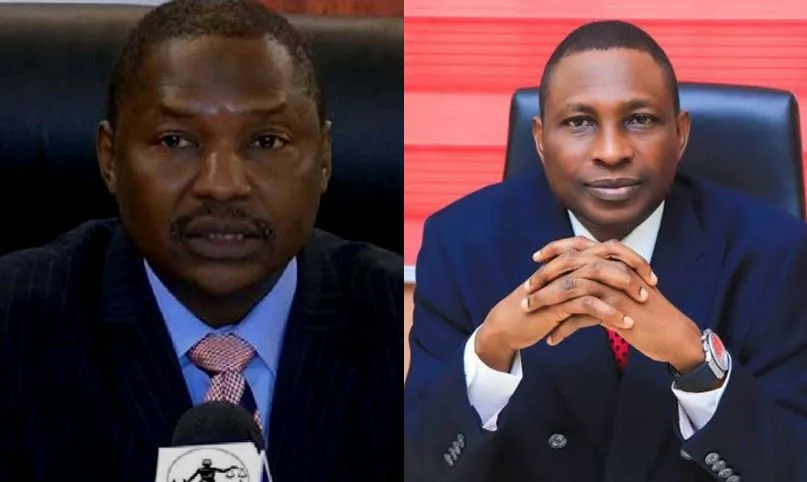


Former Attorney-General of the Federation and Minister of Justice, Abubakar Malami, SAN, has called for the immediate recusal of the Chairman of the Economic and Financial Crimes Commission (EFCC) Ola Olukoyede from all matters concerning him, citing alleged bias arising from Chapter 9 of the Justice Ayo Salami Judicial Commission of Inquiry Report.
Malami is currently undergoing investigations under the EFCC over alleged bridge of trust while he served as AGF from 2025 to 2023.
In a statement by his media aide, Mohammed Bello Doka, Malami said the EFCC Chairman’s continued involvement in the case is legally and constitutionally improper, given his prior role as Secretary to the Salami Judicial Commission set up during Malami’s tenure as Attorney-General.
According to the statement, Chapter 9 of the Salami Report examined the conduct of senior EFCC officials and raised issues of institutional accountability that allegedly created professional exposure for individuals now exercising prosecutorial authority over Malami.
The statement argued that, based on this history, a reasonable apprehension of bias exists and that under Nigerian law, recusal is mandatory where such apprehension arises.
Malami’s office further alleged that the EFCC’s actions have resulted in violations of his constitutional rights, including the rights to personal liberty and fair hearing, as well as subjecting him to trial by media through selective leaks and public commentary.
The statement also accused the commission of harassment without timely arraignment and of attempting to criminalise policy decisions taken while Malami was in office, rather than identifying specific criminal offences.
Reiterating Malami’s position, the statement said the former Attorney-General is willing to submit to a neutral and independent investigation and insists that any charges should be filed before a court of competent jurisdiction.
The statement called for the intervention of the current Attorney-General of the Federation to transfer the matter to an independent investigative authority and ensure due process.
“This is not a personal dispute but a constitutional issue,” the statement read in part.
The aide warned that the use of anti-corruption agencies for personal grievances could undermine the rule of law.