
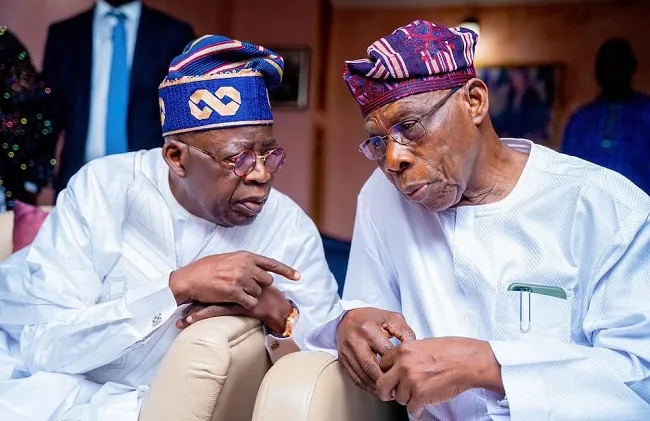
Former President Olusegun Obasanjo on Wednesday expressed pessimism about Nigeria’s economic outlook under President Bola Tinubu, saying he sees no indication that the country’s economic situation is improving.
Obasanjo also questioned the rationale for seeking a second term for Tinubu to consolidate his economic policies, arguing that the reforms had impoverished Nigerians and had not served their best interests.
The former president spoke during a keynote interview at the ongoing Financial Times Africa Summit 2026 in London, United Kingdom, where he criticised the administration’s handling of the economy, particularly the devaluation of the naira and the removal of petrol subsidy.
Reacting to the sharp depreciation of the naira, Obasanjo said the policy had significantly reduced the purchasing power of Nigerians and contributed to the country’s position as the poverty capital of the world.
“We do not live in isolation as a country. We interact with the rest of the world. And overnight, you devalue the currency by 300 percent. The naira went from N500 to a dollar to N1,500 to a dollar. What that meant was that every Nigerian is made poor by 300 percent. That made Nigeria to become the poverty capital of the world, which means Nigeria has the largest number of poor people in the world. You cannot say to me that that is good for Nigeria. You cannot say to me that that is good for us in any sense,” he said.
On the removal of petrol subsidy, Obasanjo argued that corruption accounted for a substantial part of the cost of maintaining the subsidy regime, insisting that tackling corruption could reduce the amount of subsidy required.
“Petrol and petroleum products affect everybody and everything. Now, what we call subsidy for petroleum products in Nigeria, a lot of it is corruption. And I believe that if we pay attention to corruption and deal with corruption, then what will remain of subsidy will be very little. If we take care of corruption in the system, I believe that the subsidy that we will need will be much more less,” he said.
When asked whether Tinubu deserved a second term to see his policies through and consolidate on their gains, the former president challenged the premise of the question.
“What policies are you seeing through? You impoverish your people and you want to see impoverishment through? What are you seeing through?” Obasanjo asked.
Obasanjo also compared Nigeria’s economic performance with that of Ghana, citing the movement of the Ghanaian cedi against the United States dollar as an example of a different economic trajectory.
“Now compare the situation in Nigeria with Ghana. I understand that the present president of Ghana… took over when cedi was 16 cedis to a dollar. Within six months, he took it to 10 cedis to the dollar. You can see the difference. What do you say to that?” he said.
He added that Ghanaian cocoa farmers had reportedly appealed to their president over the decline in the price they received for their produce, prompting a slowdown in the currency’s appreciation.
“In fact the cocoa farmers went to beg him and say the price we are getting for cocoa is getting a bit less. Slow down, now it has now gone to 11.5 cedis to the dollar,” Obasanjo said.
Asked whether he would support Tinubu for a second term, the former president said his criticism was directed at the administration’s economic policies rather than the president’s position in office.
“Don’t bring it that way. Now he has become president before he started doing what he is doing. What he is doing wrong and what I am saying is the economic programmes that he has put in place, they have not been in the best interest of Nigerians. Pure and simple. Nobody can deny that,” he said.
He added: “If Nigeria after he took over has become the capital of poverty of the world, then that says something.”
Obasanjo, however, rejected suggestions that his criticism of Tinubu meant he considered the administration of former President Muhammadu Buhari successful.
“I did not say Buhari did well either. If you read my book about Buhari, I wasn’t polite. I said Buhari does not understand economics and he does not understand foreign affairs. And I was proved right,” he said.
The former president urged attention to remain on the economic and social welfare of Nigerians rather than the personalities of other presidential contenders.
“For now we are not talking about the other presidential candidates. Let us talk about economics and social interest in Nigeria and then the situation in Africa,” he said.
Asked whether he saw any sign of hope for the Nigerian economy, Obasanjo said he remained unconvinced that conditions would improve under the current trajectory.
“What will get better? For the economy, I don’t see anything getting better,” he said.
He identified tackling corruption, wastefulness and excessive spending, alongside increased domestic production as essential measures for improving the country’s economic prospects.
“If you are in a very bad economic situation. Two things among others to me are very important. You must curb corruption, wastefulness and unnecessary luxury. So, you must be very careful how you spend money. You shouldn’t be spending money like a drunken sailor. Number two, you must produce,” Obasanjo said.

