



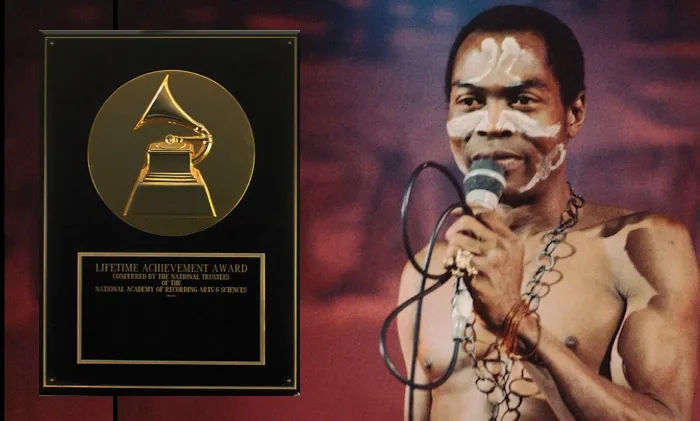


Twenty-nine years after his death, Afrobeat pioneer and cultural icon, Fela Anikulapo-Kuti, is to be honoured with a Grammy Lifetime Achievement Award by the Recording Academy, organisers of the world’s most prestigious music prize.
The honour will be conferred at the 68th Grammy Awards ceremony holding in Los Angeles on January 31, 2026, ahead of what would have been his 88th birthday on October 15.
The award will be received by his children, Yeni, Femi and Kunle Kuti, representing the Kuti family and the global Afrobeat community. The Grammy Lifetime Achievement Award, established in 1962, recognises performers who, during their lifetimes, made outstanding creative contributions of artistic significance to the recording field. The Academy credited Fela with creating Afrobeat and influencing generations of artists across Africa and the world, including global stars such as Beyoncé, Paul McCartney and Thom Yorke.
Widely regarded as the architect of Afrobeat, Fela fused highlife, jazz, funk and traditional Yoruba rhythms with extended horn arrangements and politically charged lyrics, producing a revolutionary sound that later became the foundation of modern Nigerian and African popular music now known globally as Afrobeats.
Over the course of his career, he composed, recorded and performed more than 200 songs. In 2025, his seminal 1976 album Zombie was inducted into the Grammy Hall of Fame, an honour accepted by his sons Femi and Seun Kuti. Although Fela never received a Grammy nomination while alive, his family has continued his musical legacy, earning multiple nominations over the years.
Beyond music, Fela was a fearless activist who used his art to challenge military rule, corruption and social injustice in Nigeria, often at great personal cost. His influence endures through institutions such as the New Afrika Shrine, the Kalakuta Museum and the annual Felabration festival, which celebrate his life, music and ideals.
The posthumous Grammy Lifetime Achievement Award stands as a global recognition of Fela Anikulapo-Kuti’s enduring impact as a musician, revolutionary and one of Africa’s most influential cultural figures.