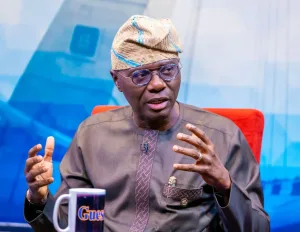


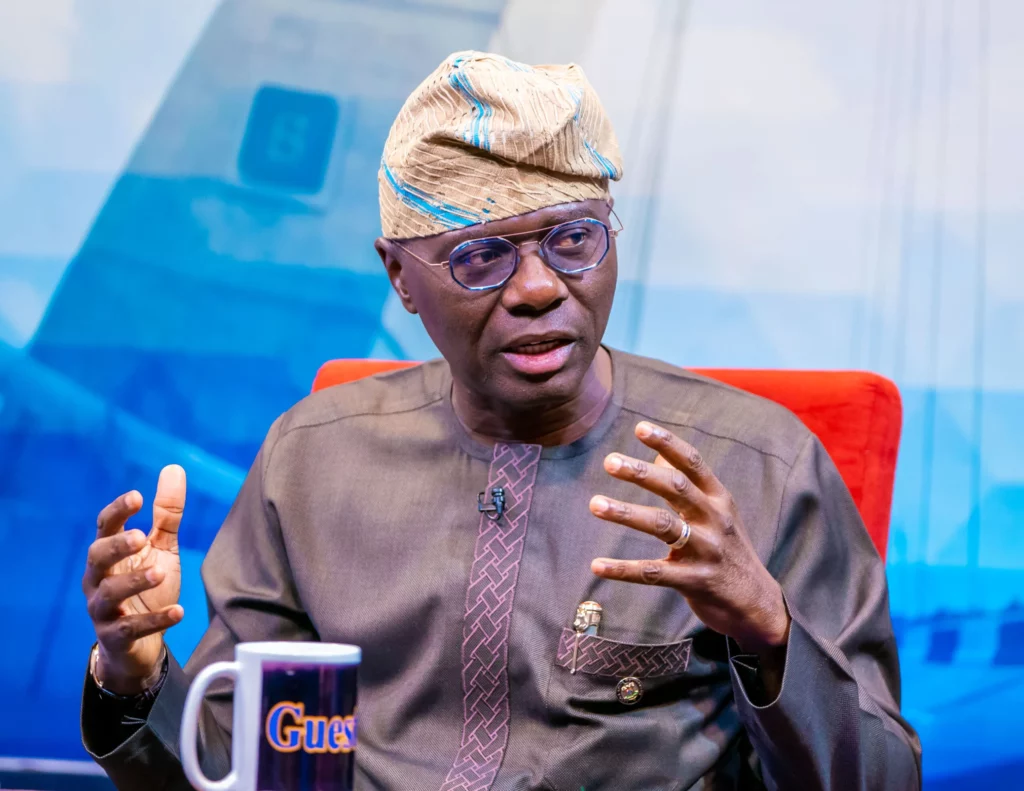


The Lagos State governor, Babajide Sanwo-Olu, has explained why his administration is pushing infrastructural development into neighbouring Ogun State, citing the rising cost of land development, the coastal terrain of Lagos and increasing urbanisation.
Sanwo-Olu said the Lagos State government was working with Ogun State to establish joint cities and development zones around border communities to accommodate the growing population and ease pressure on housing and infrastructure in Lagos.
The governor spoke on Thursday during the Financial Times Africa Summit in London, where he addressed the rising cost of living in Lagos. He participated in the discussion virtually.
According to him, Lagos faces geographical limitations that make construction more expensive, forcing developers to explore neighbouring Ogun State, where the terrain is more suitable for large-scale development.
“Secondly, in terms of housing, the geography or the terrain of Lagos is not like any other part of the city. We are in the coastal region where to do two, three levels of development, you need to be able to have some level of piling.
“The cost to even go on the ground before you come out to the surface, we are below the sea level. So, it just increases our cost. That is why you see that development is moving more into our neighbouring state, which is Ogun State, and we don’t have any apology for that because we don’t have any other neighbour other than Ogun State,” he said.
The governor said the state was deliberately encouraging development in Ogun State because its land was more stable, allowing developers to undertake more construction at a relatively lower cost.
He added that the Lagos and Ogun state governments were collaborating to develop border communities and provide infrastructure and essential services for residents who live in Ogun State but travel to Lagos for work.
“We are creating a lot of joint cities or joint development zones all around the border towns. We are actually the ones pushing a lot of infrastructural developments into that region in terms of police, traffic management, response of emergencies and so on,” Sanwo-Olu said.
He added that the Lagos government was extending support to these areas to ensure that people living there could commute to Lagos to earn a living.
“We take care of everything so that when people even go to live there, they can still find a journey back to Lagos to come and work and earn a living,” he said.
On the rising cost of living, Sanwo-Olu said the state had taken steps to ease transportation costs through an integrated public transportation system that allows residents to travel by road, rail and waterways.
He disclosed that more than 5.2 million Lagos residents were using the cowry card, a unified payment system for public transportation.
The governor said the structured transportation system also served as a form of subsidy, helping to prevent the full impact of rising fuel prices from being passed on to commuters.
“It is true that it has gone up but part of the things that we have done to reduce that is that the structured transportation system is like a subsidy that the government also ensures that we pass to them so that they don’t pass the entire cost to the passengers,” he said.
On calls for more affordable housing, Sanwo-Olu argued that the high cost of building materials remained a major challenge, noting that cement and iron rods were expensive regardless of the category of housing being constructed.
“There is really nothing affordable because there is no affordable cement or affordable iron rod. It is the same cost of iron rod. There is no one iron rod that we said it has to be cheaper for some set of people or some cement that will be cheaper for other set of people,” he said.
He said the government needed to find ways to deliver housing at scale while reducing bottlenecks in accessing the resources and materials required for construction.
Sanwo-Olu identified rapid urbanisation as another major challenge, explaining that the continuous influx of people into Lagos was putting additional pressure on housing and public infrastructure.
He said Lagos could not prevent Nigerians from other parts of the country from moving into the state, making sustained investment in infrastructure and housing necessary.
“What Lagos needs to do is to continue to build. We cannot move into the Atlantic Ocean, we can only move north, which is Ogun State, and we are working with Ogun State,” he said.
On insecurity, the governor attributed the harassment of tourists and residents by street hoodlums in the state partly to the display of wealth on social media.
A participant at the summit had asked how the state government intended to address the problem, noting that the activities of street criminals could undermine Lagos’ reputation as a major tourist destination.
Responding, Sanwo-Olu said some social media influencers and other individuals who publicly flaunt large sums of money could attract unwanted attention from people who believe they are entitled to a share of their wealth.
“What has happened is that a lot of people are using social media to express wealth, to showcase how much money they suddenly all gotten,” he said.
“You go to some influencers page and people are unreasonably and shamelessly displaying cash as a way of telling their followers that they have arrived.”
According to Sanwo-Olu, such display could encourage some people to target those individuals on the streets.
“When these set of people now get accosted on the streets, it is to say that ‘we saw you yesterday posting that you have N10m cash, give us out of it’,” he said.
While stressing that nobody should be harassed for displaying their wealth, the governor urged people to exercise restraint in showcasing their financial status online.
“Whilst I am not going to speak that anybody should be harassed for displaying his or her wealth, I think we also can have a lot of restraint,” he said.
He argued that the public display of wealth could expose individuals and their families to pressure from people who question how they acquired their money.
Sanwo-Olu, however, identified removing vulnerable and criminally inclined individuals from the streets, providing vocational training and strengthening social support systems as part of the government’s broader response.
He said the state government had been taking people off the streets and providing them with opportunities to acquire skills, but noted that some returned to Lagos from other parts of the country.
The governor disclosed that the government was working towards establishing a Lagos Resident Identity system to help identify residents, their locations and their occupations.
According to him, the proposed system would enable the government to gather data on residents’ needs and determine the skills, trades and other forms of support that could help them become economically productive.
“With that we can use data to ask you what you require of government. What kind of skills do you want to learn? What kind of trade can we support you with?” he said.
He added that the government needed to distinguish between people engaging in street activities because of unemployment and those involved in criminal conduct.
“Because quite frankly, there are people that we need to take off the streets. If you are criminally inclined, it is for government to do the right thing by taking you off the streets and be able to deal with it,” he said.
Sanwo-Olu also announced that the state was building what he described as the largest mental health facility, saying it would provide support for people who require mental health care and help address challenges associated with vulnerable individuals living on the streets.
“For the ones that are criminal, let’s also be able to deal with it. It is a hydra-headed solution,” he said.
The governor maintained that tackling street harassment required a combination of interventions, including skills acquisition, social support, mental health services and action against criminal activities.